Priene and Magnesia ad Maeander: main architectures and urban morphology
Parole chiave:
architecture, archaeology, urban development, survey, digital survey, 3D , laser scanning, UAV, photogrammetry, mappingAbstract
Priene and Magnesia ad Maeander constitute two emblematic case studies
for investigating Hellenistic urban planning, architectural form,
and the relationship between cities and their environmental settings
in western Anatolia. Both settlements developed within the Maeander
valley during the Hellenistic period, under complex political and
cultural conditions following Alexander the Great’s conquests, and later
underwent significant transformations during Roman rule before
abandonment. Despite differences in scale, origin, and topographical
context, the two cities share fundamental planning principles rooted
in the Hippodamian urban model, characterized by orthogonal layouts
and a clear hierarchy of civic, religious, and residential spaces. Priene,
founded on the steep slopes of Mount Mykale, represents one of
the most complete examples of an orthogonal urban system adapted
to a challenging terrain. Its preserved street grid, domestic quarters,
and monumental buildings, including the Temple of Athena Polias,
reflect the ideological coherence of Hellenistic urbanism. Magnesia
ad Maeander, established in a flatter landscape, developed on a larger
scale, enabling the construction of extensive monumental complexes
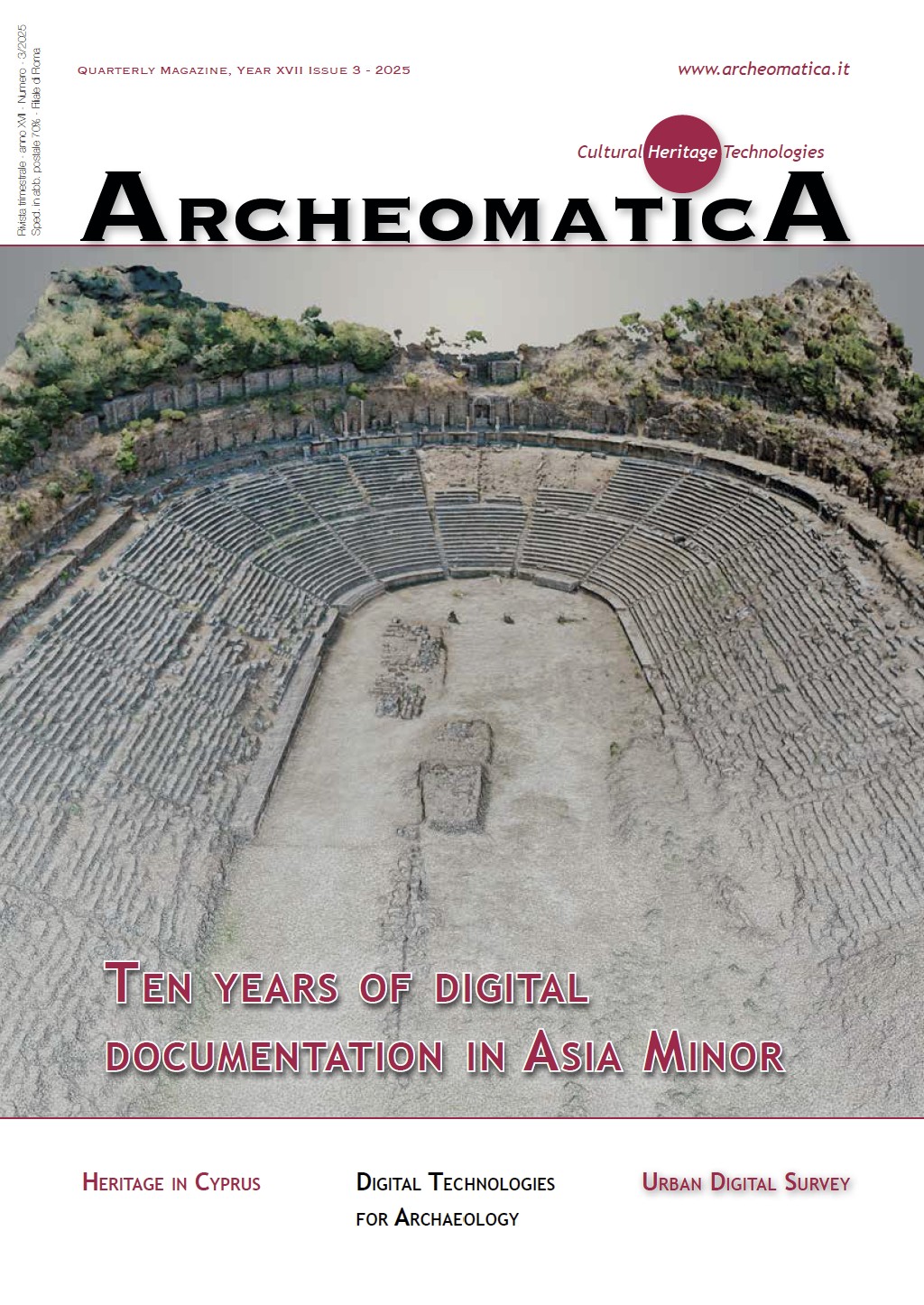
such as the Artemision and the stadium, which expressed civic identity
and regional importance. The impact of environmental dynamics,
including seismic activity and fluvial processes, have a significant
impact on the urban evolution of both cities. Recent digital survey
campaigns using photogrammetry and 3D laser scanner technologies
in the present time, are essential tools for documenting, analysing,
and interpreting these complex archaeological contexts.
Riferimenti bibliografici
Bingol, O. (1998). Magnesia ad Maeandrum: Magnesia on the Meander. Turchia: Dönmez Offset.
Humann, C. (1904). Magnesia am Maeander. Bericht uber die Ergebnisse der Ausgrabungen der Jahre 1891–1893. Berlin, Reimer.
Dunand, F. (1978). Sens et fonction de la fête dans la Grèce hellénistique. Les cérémonies en l’honneur d’Artémis Leucophryéné, in Dialogues d’histoire ancienne, n. 4, pp. 201-215.
Talbert, R.J.A., (2000) Barrington Atlas Map-by-Map Directory (Two-Volumes), Princeton University Press.
Wycherley, R. E. (1945). Priene and Modern Planning, in Greece & Rome, Jan., 1945, Vol. 14, No. 40 (Jan., 1945), pp. 12-16, Cambridge
University Press on behalf of The Classical Association.
Dowloads
Pubblicato
Fascicolo
Sezione
Licenza
Gli autori che pubblicano su questa rivista accettano le seguenti condizioni:- Gli autori mantengono i diritti sulla loro opera e cedono alla rivista il diritto di prima pubblicazione dell'opera, contemporaneamente licenziata sotto una Licenza Creative Commons - Attribuzione che permette ad altri di condividere l'opera indicando la paternità intellettuale e la prima pubblicazione su questa rivista.
- Gli autori possono aderire ad altri accordi di licenza non esclusiva per la distribuzione della versione dell'opera pubblicata (es. depositarla in un archivio istituzionale o pubblicarla in una monografia), a patto di indicare che la prima pubblicazione è avvenuta su questa rivista.
- Gli autori possono diffondere la loro opera online (es. in repository istituzionali o nel loro sito web) prima e durante il processo di submission, poiché può portare a scambi produttivi e aumentare le citazioni dell'opera pubblicata (Vedi The Effect of Open Access).