Magnesia ad Maeander, the Stadium, a matter of scale
DOI:
https://doi.org/10.48258/ARC.2025.I3.2164Parole chiave:
architecture, archaeology, 3D model, UAV, drones, photogrammetry, mesh, texture fotograficaAbstract
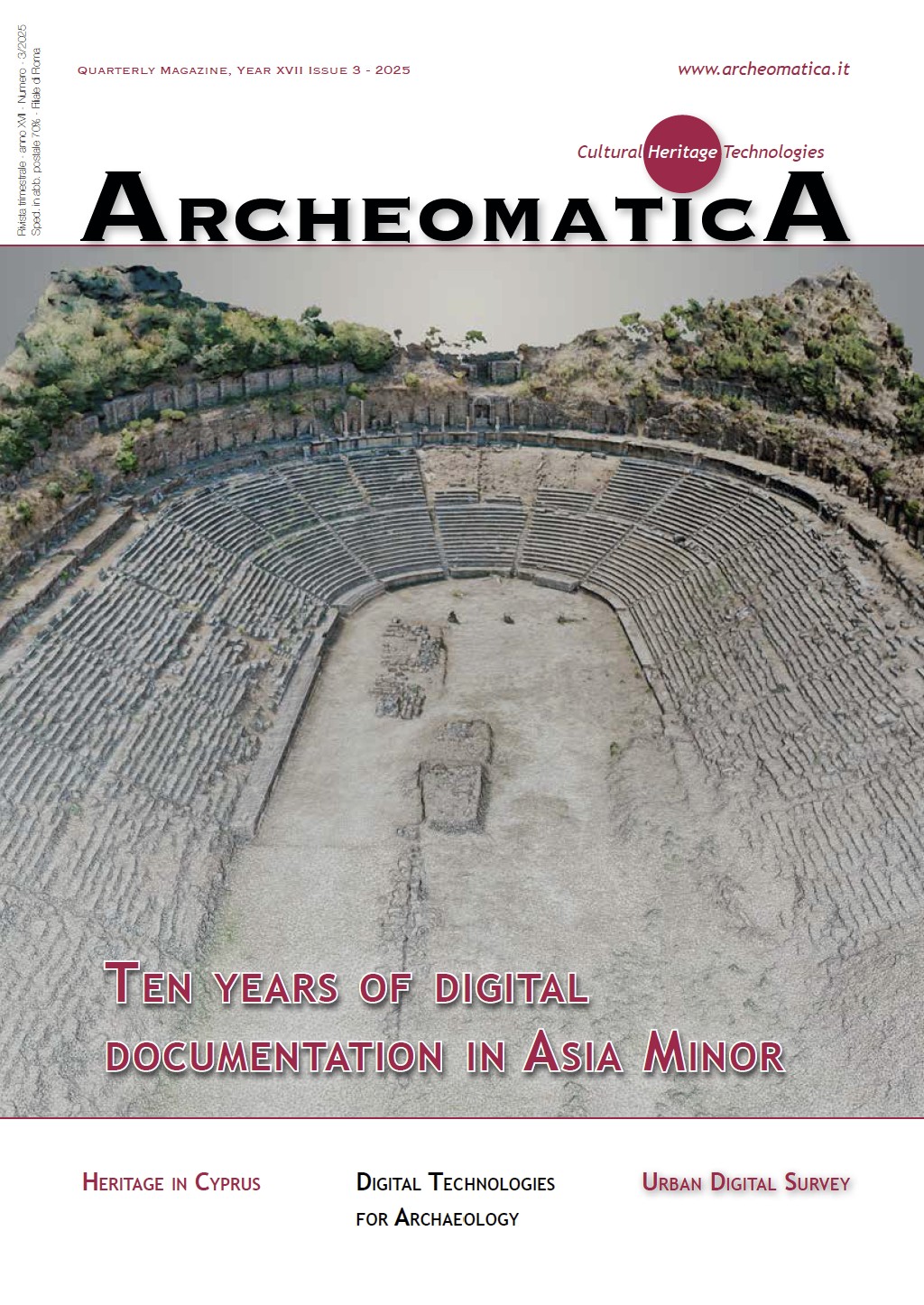
The Stadium of Magnesia ad Maeander represents one of the most monumental and well-preserved athletic
architectures of Asia Minor, distinguished by its scale, architectural complexity, and rich cultural significance.
Built in the first century AD along the slopes of two hills, the stadium accommodated approximately 30,000
spectators, closely connected to the city’s civic life. Archaeological investigations have progressively revealed its
architectural layout, installations for athletic competitions, and extensive sculptural and epigraphic programs.
Originally associated with the Leucophryena festival dedicated to Artemis, the stadium hosted a wide range of
events. Architectural analysis, however, suggests that its design was optimized primarily for athletic and light
equestrian activities rather than full-scale chariot racing. Of particular importance are the reliefs decorating
the podium walls and the numerous inscriptions carved on seating and architectural elements, which provide valuable
insights into social stratification, professional associations, inter-city relations, and elite patronage within
Magnesia. Recent digital documentation campaigns employing UAV and terrestrial photogrammetry have enabled
the creation of high-resolution 3D models of the stadium and its sculptural elements. These digital datasets
support multi-scalar analysis, enhance interpretative possibilities, and contribute significantly to the long-term
study, conservation, and dissemination of this exceptional architectural complex.
Dowloads
Pubblicato
Fascicolo
Sezione
Licenza
Gli autori che pubblicano su questa rivista accettano le seguenti condizioni:- Gli autori mantengono i diritti sulla loro opera e cedono alla rivista il diritto di prima pubblicazione dell'opera, contemporaneamente licenziata sotto una Licenza Creative Commons - Attribuzione che permette ad altri di condividere l'opera indicando la paternità intellettuale e la prima pubblicazione su questa rivista.
- Gli autori possono aderire ad altri accordi di licenza non esclusiva per la distribuzione della versione dell'opera pubblicata (es. depositarla in un archivio istituzionale o pubblicarla in una monografia), a patto di indicare che la prima pubblicazione è avvenuta su questa rivista.
- Gli autori possono diffondere la loro opera online (es. in repository istituzionali o nel loro sito web) prima e durante il processo di submission, poiché può portare a scambi produttivi e aumentare le citazioni dell'opera pubblicata (Vedi The Effect of Open Access).